

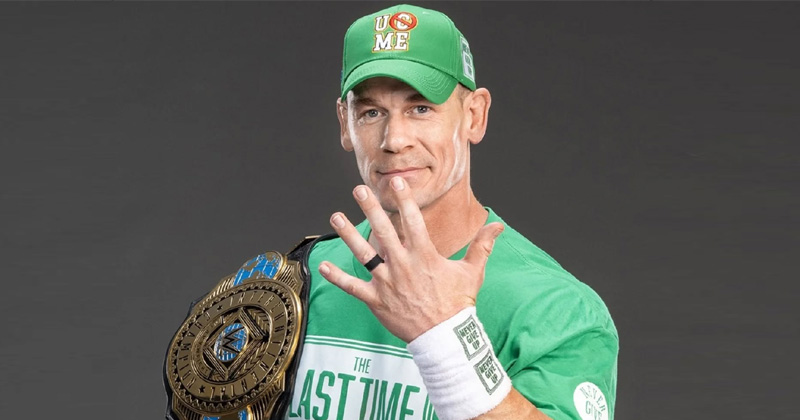
A love letter to the constant presence who carried a generation and helped us grow up along the way
I’ve always marveled at how nostalgia is such a hell of a drug.
It doesn’t ask for permission. It just pulls you back, with the flip of a switch, into a version of life that felt simpler, slower, and lighter. A time when joy came easily and responsibilities hadn’t yet saved your name in its contacts.
Seeing a juggernaut like John Cena who, as a matter of fact, lived rent free in a big chunk of my childhood (and the entirety of my wrestling fandom) – was an easy, instant teleportation back to the days when you could just chill, relax, have no worries, have no job, have no responsibilities, and enjoy life for what it was.
I still remember the night he answered Kurt Angle’s open challenge.
“Ruthless Aggression” wasn’t just a tagline. It felt raw, unscripted, and real. Sure Cena didn’t walk out as a finished product. But he walked out with intensity, defiance, and a hunger that was impossible to ignore. That moment didn’t feel like a debut. It felt like a spark that gained the then locker room leader The Undertaker’s praise.
Then came the freestyle rap gimmick, something that could have easily flopped, but instead became lightning in a bottle. It gave him a voice, a presence, and an identity in an era desperately searching for its next anchor. Love him or hate him, he connected with those in attendance and the millions watching at home. And before we realized it, John Cena was no longer climbing. He had arrived.
What makes his rise remarkable isn’t just where he ended up, but when it happened. He didn’t inherit a booming kingdom. He carried the company from the zenith of vulnerability through one of its most uncertain transitions that saw uber popular megastars namely The Rock and “Stone Cold” Steve Austin call it quits. The gargantuan superstar vacuum created by their departures was overwhelming and at times felt impossible to fill.
But John Cena didn’t just step into that void. He held it together.
For more than a decade, he became the face of WWE, not because everyone loved him but because he was reliable, visible and relentless. He endured polarising reactions, impossible expectations, and constant scrutiny throughout the entirety of the PG era. He showed up to every televised show, every house show, every PPV/PLE as the company’s flag bearer.
What makes his story resonate even deeper is knowing where he came from.
When Cena entered OVW in the early 2000s, he wasn’t alone. He came in alongside Batista, Randy Orton, and Brock Lesnar. Three men who, on paper, had far more natural gifts. Batista had the physique. Orton had the lineage and smoothness. Lesnar was a once-in-a-generation athletic phenomenon.
And then there was Cena. No freakish athleticism. No effortless technical mastery. No immediate aura that screamed “future face of the company.” At the time, he was arguably the least naturally talented of the group. But he was relentless. He learned. He adapted. He improved. Where others relied on what came easily, Cena treated wrestling like a craft to be mastered.
He rose above them all like he rose above hate. Not through shortcuts, but through persistence. Not by being the best on day one, but by refusing to settle for second best.
That’s why “Hustle, Loyalty, Respect” was never just a slogan on merchandise. It was embedded in the very fabric of his modus operandi. Hustle was consistency. Loyalty was commitment through adversity. Respect was earned through endurance, not demanded through status.
To see him leave is a poignant curtain call, the final, unmistakable severing of the last fragile thread connecting me to the golden, care-free days of the 2000s – a bittersweet reminder that some eras don’t just end… they quietly vanish. Vanish with a ‘smile of acceptance of the inevitable’ ……. just like the man himself
Thank you, John.
The Greatest of All Time
The never seen seventeen
The last real champion
— A tribute written by Navid Khan